
.jpg)
PROTECT YOUR DNA WITH QUANTUM TECHNOLOGY
Orgo-Life the new way to the future Advertising by Adpathway 
Winter hiking often requires traction aids like microspikes or crampons, which give your feet better grip on ice and packed snow and help prevent slips and falls on hard ice. The products listed below are designed for increasingly demanding conditions, from packed snow and icy trails to non-technical mountaineering on ice, snow slabs, and rock. All of them work with soft-soled insulated winter hiking boots and trail runners, as well as conventional mountaineering boots with rigid soles and toe or heel welts.
| Kahtoola Microspikes | $90 | Packed snow, icy trails |
| Hillsound Trail Crampon Ultra | $70 | Packed snow, icy trails |
| Hillsound Trail Crampons | $85 | Packed snow, icy trails |
| Black Diamond Distance Spikes | $120 | Packed snow, icy trails |
| Hillsound Trail Crampon Pro | $100 | Mixed ice, snow, and rock |
| Kahtoola K10 Crampons | $140 | Mixed ice, snow, and rock |
| Kahtoola KTS Crampons | $180 | Mixed ice, snow, and rock |
| Black Diamond Contact Strap Crampons | $190 | Non-technical mountaineering |
| Petzl Irvis FLexlock Crampons | $200 | Non-technical mountaineering |
| Grivel G10 New Classic Crampons | $176 | Non-technical mountaineering |
Read our Winter Traction Devices and Crampons FAQ below to learn about these winter traction aids and crampons, and how to choose the right ones for your adventures. On extended winter hikes, you often need to carry more than one, plus snowshoes, depending on the conditions you’ll encounter. They’re heavier, but you’ll be glad you carried them when you need them.
1. Kahtoola Microspikes
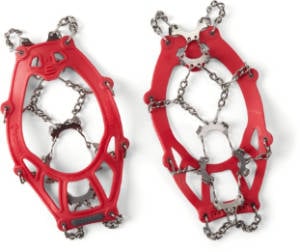
Kahtoola Microspikes redefined winter traction when they first became available a decade ago because they had elastomer harnesses that were compatible with non-technical winter hiking boots and soft-soled trail shoes. Unlike traditional spiked crampons, they use loosely coupled spike assemblies connected by chains, providing excellent traction on packed snow and icy trails. They don’t require special training, and their stainless steel spikes can take a beating on icy trails. You can also use them with running shoes, but they can put pressure on the toe box, causing friction and discomfort (see the Black Diamond Distance Spikes below as an alternative). Weight: 312 g/pair. Read our Microspikes Review.
2. Hillsound Trail Crampon Ultra

The Hillsound Trail Crampon Ultra is quite similar to Kahtoola Microspikes but has slightly longer spikes. Like microspikes, these use loosely coupled spike assemblies suspended from a stretchy elastomer harness, optimized for soft-soled winter hiking or mountaineering boots. They can also be used with running shoes, but they can put pressure on the toe box, leading to friction and discomfort (see the Black Diamond Distance Spikes below as an alternative). The Hillsound Ultras come with a horizontal Velcro safety strap to prevent loss if one pops off and you don’t notice it missing, which does happen. Many winter hikers prefer the Hillsound Ultras over Kahtoola Microspikes for this reason, but both products provide many of the same benefits and can be used interchangeably. Weight: 422 g/pair. Read the SectionHiker Trail Crampon Ultra Review.
3. Hillsound Trail Crampons

Hillsound Trail Crampons are more aggressive than the Hillsound Trail Crampon Ultras with longer spikes for trails that have thicker and much harder ice. They use an elastomer binding that works with all footwear, and their spikes are organized into plates, like a cross between Hillsound Trail Crampon Ultras and Trail Crampon Pros. They’re also suitable for packed snow, but they’re more prone to snowballing than Hillsound Ultras. A proper fit also keeps the spikes from sliding off your soles, but in the right conditions, they feel like you have claws. Weight: 462 g/pair. Read our article on How to Choose between all three of Hillsound’s Trail Crampon products.
4. Black Diamond Distance Spikes

Black Diamond Distance Spikes are specifically designed for use with trail runners and have a softshell toe binding that holds them onto the forefoot to prevent toe friction and cold toes, which are big problems when using other traction aids with elastomer bindings such as Kahtoola Microspikes or Hillsound Ultras with trail running shoes. The stainless steel spikes underfoot are linked with loosely coupled assemblies and chains to minimize pressure points and snowballing while optimizing toe-off engagement. Weight: 230 g/pair. Read the SectionHiker Distance Spikes Review.
5. Hillsound Trail Crampons Pro

Hillsound Trail Crampon Pros have a unique ratchet-style binding that makes them much easier to use and more secure than mountaineering crampons with a universal binding. They feature a tool-free adjustment mechanism and anti-balling plates that prevent snow from clumping underneath. They work best with boots rather than trail runners, where they can cause toe pressure if they’re too tight. They’re made with heat-treated carbon steel and are quite durable for use on ice and rock. Weight: 667 g/pair. Read our Trail Crampon Pro Review.
6. Kahtoola K10 Crampons

Kahtoola K10 Crampons are 10-point crampons designed for use with hiking boots (regular or insulated) or trail shoes. With a flexible leaf spring and lightweight Chromoly steel, the K10 Crampons feature 1.9 cm spikes and come with synthetic anti-balling snow-release skins that prevent snow from balling up under the spikes. The length of the crampon frame is adjustable without tools, and the strap-based binding system is easy to adjust. Weight: 652 g/pair with snow-release skins. Read the SectionHiker K10 Crampon Review.
7. Kahtoola KTS Crampons

Kahtoola’s KTS Crampons are quite similar to the Kahtoola K10 Crampon described above but have longer 1″ spikes. They feature a flexible spring-center bar compatible with all footwear and fold up small for better packability. The included synthetic snow release skins help prevent snowballing, like more conventional crampons with anti-balling plates. When fitted properly, the front toe binding does not compress your toes, which can be a big issue when using the crampon with trail runners or soft boots. Weight: 652 g/pair Read the SectionHiker KTS Crampon Review.
8. Black Diamond Contact Strap Crampons

The Black Diamond Contact Strap is a general-purpose crampon suitable for beginner use and available with multiple binding systems, including the universal binding shown here. It has a tool-free length adjustment system and comes with preattached anti-balling (ABS) plates. Best used with boots, the Contact Strap features a flexible center bar compatible with all boot types, rigid and soft-soled. It tops out at a size 10.5M; however, you can purchase a longer flex bar for larger boot sizes. The Contact Strap Crampons are made of stainless steel, so they won’t rust, and they weigh 808 g/pair. The Contact Straps were the first crampons I ever bought, and while they were awesome then, they’ve been significantly improved since. Read our dated Contact Strap Review.
9. Petzl Irvis FlexLock Crampons

The Petzl Irvis is a 10-point steel crampon with a tool-free length adjustment that comes with anti-balling plates. It has a universal binding with a linking bar that can be set for flexible or semirigid modes for flexible or rigid boots. Petzl reduced the weight of this latest model by thinning the frame without sacrificing strength. A longer linking bar is also available for boot sizes over 11.5M. Weight: 710 g/pair.
10. Grivel G10 New-Classic EVO Crampons
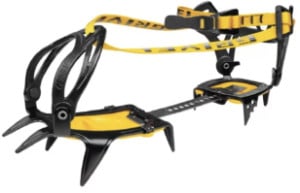
Grivel’s G10 New-Classic EVO Crampons also have a flexible center bar and universal binding system which makes them compatible with flexible and rigid boots. They have 10 points (6 in the front and 4 in the back) that provide stability in all snow and ice conditions. These steel crampons are also equipped with proactive anti-balling plates both in the front and back, which unload snow buildup with every step. Weight 861g/pair.
Winter Traction Devices and Crampons FAQ
If you’ve never used winter traction aids or crampons, it can be quite confusing to understand what you need and when to use it. Here are answers to some of the most common questions people have, but if you have others, please ask away in the comment section below and we’d be happy to answer them.
I’ve just started winter hiking, what do I need to buy?
Start with Kahtoola Microspikes or Hillsound Trail Crampon Ultras. If you hike in more mountainous terrain, I’d also recommend getting Hillsound Trail Crampon Pros or Kahtoola KTS Crampons. If you need to snowshoe, buy those too. That should cover most bases.
What are microspikes?
Microspikes, also called trail crampons, are winter traction aids that act like tire chains for your boots or trail shoes. They usually have 1-1.5 cm spikes attached to chains with elastic harnesses that slip onto your footwear. They work best on packed snow and icy trails but are uncomfortable for walking on paved surfaces.
What is the difference between microspikes and crampons?
The main difference between microspikes and crampons is spike length. Microspikes, also called trail crampons, have 1-1.5 cm spikes, while crampons have spikes that are up to 5 cm in length. Microspikes are for hiking on packed snow and thin ice, while crampons are for thicker ice, rock, and snow slabs.
Do you need to carry multiple winter traction devices on hikes or is one sufficient?
It really depends on where you are hiking and the conditions. But for lengthy winter hikes at multiple levels of elevation (i.e. mountainous terrain), it is often necessary to carry microspikes, crampons, and snowshoes so that you have the correct level of traction or flotation for the surface conditions you’re likely to encounter. Too much traction, and you’ll wear yourself out strapping heavy traction aids to your feet or twist an ankle by using mountaineering crampons when microspikes are more appropriate.
Do microspikes wear out?
Microspikes do wear out over time, and the tops of their triangular spikes flatten, giving less grip on ice. You can sharpen them with a mill bastard file, but you’ll eventually have to replace them.
What are rock spikes?
Rock spikes are worn-out microspikes. Many hikers keep them for early winter or spring conditions, when trails still have lots of exposed rock and a thin coating of ice, to preserve their newer, sharper microspikes for winter use on thicker ice and packed snow.
What is the difference between ice cleats and microspikes?
Ice cleats and ice screws penetrate less than microspikes and suit more casual home or urban use. Ice cleats are often part of a strap-on overshoe that adds traction.
What is an elastomer binding?
Microspikes and trail crampons use a stretchy, elastic binding that fits all types of footwear, from soft-soled winter hiking boots and trail shoes to rigid-soled mountaineering boots. The elastomer remains flexible down to -20F and is highly durable for extended use.
What is a ratchet-style crampon harness?
A ratchet-style binding, like on Hillsound’s Trail Crampon Pro, works like a snowshoe binding: ridged straps feed through a buckle that locks them in place. The advantage is a secure fit, which matters on a crampon, plus the ability to tighten the binding on the fly while wearing gloves.
What is an instep crampon?
An instep crampon usually has 4-6 spikes and attaches to the instep of hiking footwear. While they add traction and are lightweight, they make it difficult to balance when walking up slopes or over rocky surfaces. People used them in the early days of mountaineering, before crampons or microspikes became popular.
Do microspikes come in multiple sizes?
Microspikes, also called trail crampons, come in different sizes based on your boot or shoe size. Fit them correctly to your footwear to prevent discomfort or friction from using microspikes that are too small. The same goes for microspikes that are too large; they can pop off your shoes and are easy to lose.
Can you walk on the pavement with microspikes?
While microspikes are made with stainless steel and are very durable, they’re not intended for walking on pavement or city sidewalks. For that, it’s better to use ice cleats or Yaktrax.
What is the difference between microspikes and crampons?
Crampons have much larger spikes designed to bite deep into ice on surfaces where falling isn’t an option. Microspikes have shorter spikes that grip ice well but penetrate less. They also use a binding system, usually an elastomer harness, compatible with multiple footwear types, while crampon/footwear compatibility is more limited.
What are anti-balling plates?
Anti-balling plates, also called balling plates, ABS plates, or snow release skins, prevent wet snow from clumping to the bottom of a winter traction device or crampon. This happens when the crampon contacts water or wet snow. Balling under a crampon is dangerous because it prevents the crampon spikes from gaining traction. Instead, you can lose control on snow or ice.
Do you need to wear gaiters with microspikes or crampons?
High mountaineering gaiters are designed, in part, to protect your legs from sharp crampon points and usually have reinforced lowers to prevent spike penetration. They’re not really necessary for protection when wearing microspikes because their spikes are much shorter. Still, gaiters also keep your pants dry in deep snow and can be worn for that purpose alone.
What is the difference between a steel crampon and an aluminum crampon?
Steel crampons are much more durable than aluminum ones and easier to sharpen when worn down. However, aluminum crampons are very lightweight and can weigh half as much as steel crampons, making them useful when you need the lightest gear.
What is a step-in crampon binding?
Step-in crampon bindings attach to special ridges, called welts, that are cut into the soles of mountaineering boots. Step-in bindings use hinged metal bars that slot into the welts, forming a tight connection to the boots. Step-in bindings are used for higher-angle mountaineering or ice climbing where you need a very secure attachment.
What is a flexible leaf spring?
The metal bar connecting the front and heel of a crampon is usually rigid when used with a stiff-soled mountaineering boot. Replace it with a flexible metal bar called a leaf spring, which lets the crampon’s front and back halves move independently when you use it with a soft-soled boot or trail shoe.
How do you walk on ice with crampons?
When you walk in crampons, make sure all your spikes stay in contact with the ice and dig in. This may involve bending your ankle and leg to keep the spikes in continuous contact or stomping down on the ice as you walk. This prevents you from sliding and falling,
Can you walk on rocks with crampons?
You often need to walk on rocks with crampons in mountainous terrain. Do so carefully to avoid twisting an ankle, and try to keep the sole of your foot as flat or perpendicular to the rock as possible.
See Also:
- Winter Traction and When to Wear It
- Hillsounds or Microspikes: How to Choose
- Hillsound Trail Crampons: How to Choose
- Camp Stalker Universal Crampon Review
- Hillsound Cypress 6 Instep-Style Crampon
- Black Diamond Contact Strap Crampon
- CAMP Nanotech XLC Crampons Review
- STABILicers Hike Macro Winter Traction Spikes Review
- Yaktrax Summit Winter Traction System Review
- How to Use Crampons
SectionHiker never accepts payment for gear reviews or editorial coverage. When you buy through affiliate links on our site, we may earn a small commission at no extra cost to you. Help us continue to test and write unsponsored and independent gear reviews, hiking and backpacking FAQs, and free hiking guides.








 English (US) ·