
.jpg)
 7 months ago
89
7 months ago
89
PROTECT YOUR DNA WITH QUANTUM TECHNOLOGY
Orgo-Life the new way to the future Advertising by Adpathway/pic8764108.jpg)
No. It was meant to teach us about management and accounting, but somehow, we had a blast playing it.
The First Attempt
Years later, in 2009, I discovered the world of "modern boardgames" with CATAN thanks to friends, and we started playing weekly, having a preference for "heavy" games of that time: Agricola, Vinhos, Caylus, Endeavor, and many more.
After a few years, I thought, "Hey, why not create my own game?" I remembered my "serious gaming" experience as a student and started to draft a board game based on it, using Excel as a prototyping tool. It was a disaster — too long, too tedious, and way too complex. I had added layers upon layers of details like logistics and real estate, thinking more complexity would make it better. Spoiler alert: It didn't!
I immediately decided to reboot the project with a theme that was more exciting than producing, transporting, and selling products in stores. That's when it hit me: treasure hunting! Instead of managing a boring old company, players would run their own underwater treasure-hunting enterprises. From the beginning, I was guided by the need for a strong connection between mechanisms and theme. This is something I hold dear because it enhances immersion and helps players remember the rules.
Worker Placement: Because Who Doesn't Love Meeples?
I quickly settled on a worker-placement mechanism. Not only do I love this mechanism, but it also fit perfectly with the theme. Players start with a few meeples: the boss and two employees. The boss has a special ability for each possible action, adding a layer of strategy right from the start.
The main actions players can take include recruiting additional employees, developing technologies to equip their ships and make them more efficient, finding treasure maps that correspond to locations on
a maritime map, and exploring the ocean floor to retrieve treasures of varying value.
Of course, there are sharks to contend with because what's treasure hunting without a bit of danger?
Testing, Testing, and More Testing
I first tested the game with my kids. They humored me, but a three-hour game wasn't exactly their cup of tea. Still, it showed me that the game had potential, even if it needed a lot of fine-tuning. I started
iterating, enlisting the help of my usual group of hardcore gamers for playtesting.
Once I had a stable version, I decided to test the waters by submitting Thesauros to the international game design competition in Boulogne-Billancourt, known as "CréaGames". To my delight, the design made it close to the final ballot, and while it didn't join the finalists, this was a huge encouragement to keep going.
/pic9114029.jpg)
Moreover, the testers at the competition provided a detailed report highlighting the strengths and, more importantly, the weaknesses of the prototype. This feedback was invaluable, giving me clear directions
on how to improve the game.
A Detour: Family-Friendly Fun
/pic8094692.jpg)
/pic3895016.jpg)
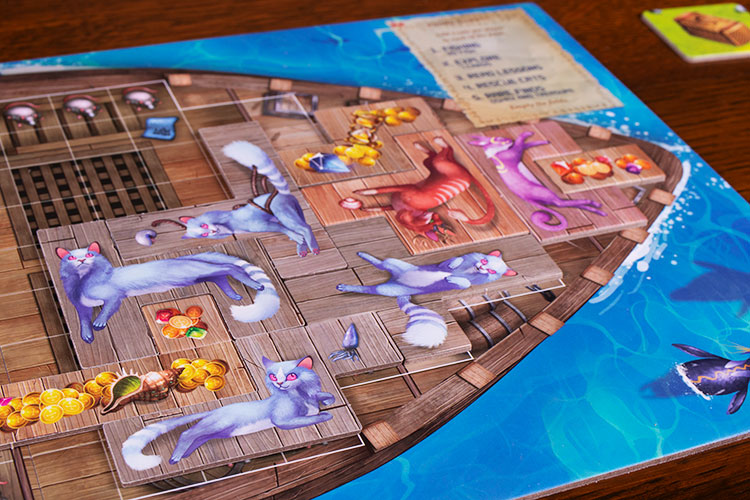
You see, my wife isn't a fan of games with rule explanations longer than fifteen minutes. I realized that if I wanted to play with her and get her feedback, I needed to design a game more suited to her tastes! This new cat game prototype and another one both landed publishing contracts, with the latter eventually becoming Meeple Circus.
Since game design is a hobby for me alongside a full-time job, I put Thesauros on hold for a few years, not picking it up again until 2017. By then, I had moved to India and found a new group of playtesters who provided fresh perspectives and great feedback.
/pic9120026.jpg)
/pic9114026.jpg)
In the new version of this prototype, I introduced a new type of action: selling the treasures found at sea to a museum. This addition addressed a flaw in the previous version in which certain areas lost interest towards the end of the game without another area taking over.
Super Meeple in the Game
After numerous iterations and playtests, in 2018 I decided to present the prototype at the "off" festival during the FIJ game fair in Cannes. Bernard from the publishing company Super Meeple sat down at my table and played a game. Afterward, he expressed interest in the prototype, and a few months later, I received the fantastic news: Super Meeple would publish the game! I was particularly thrilled because Super Meeple had built a reputation for its editorial quality.
/pic9114028.jpg)
What followed was the game development process, which involved several important decisions. First, although technologies could have controlled it entirely, many players disliked the randomness involved in exploring the maritime zones, so I proposed a different mechanism for this area.
Second, after the COVID pandemic, there was a strong demand from players to be able to play with just two people. Super Meeple asked me to look into adapting the game, which was originally designed for 3-4 players, for two players. Initially, I refused...but after some thought, I found satisfactory solutions that didn't require changing the rules. After numerous tests, we decided to include this option.
Third, Super Meeple asked me to consider a solo version. Not being a fan of solo games and somewhat opposed to the idea of having the player simulate a second player (with all the associated manipulations), I came up with a solution that I would call an "optimization challenge". The goal isn't just to achieve the best possible score; the basic victory condition is to fill the museum with treasures. Additional variable constraints are added depending on the game session. Thus, the adaptations to the multiplayer rules are ultimately limited.
Collaboration and Passion
I greatly enjoyed working with Bernard on the game's development. He had a keen eye for spotting areas that needed improvement, especially those I might have overlooked due to my long-term involvement with the project. Furthermore, Bernard shares my sensitivity to the game's theme, which made our collaboration all the more fruitful.
/pic9114030.jpg)
Creating a game like Thesauros is a long process that can come to fruition only through the passion of both the author and the publisher. A huge thank you to Super Meeple for their trust, and to their partners for bringing the game outside France: 999 Games for the Dutch version and Elznir Games for the German and English version. I hope you feel that passion when you play Thesauros, and that it brings you as much joy as I had designing and refining it!
So there you have it, folks. It's been a long ride, but ultimately, it's been an incredible experience. Now, go forth and hunt some treasures — just watch out for those sharks!
Cédric Millet
/pic9120025.jpg)
/pic9499173.jpg)








 English (US) ·