
.jpg)
PROTECT YOUR DNA WITH QUANTUM TECHNOLOGY
Orgo-Life the new way to the future Advertising by Adpathway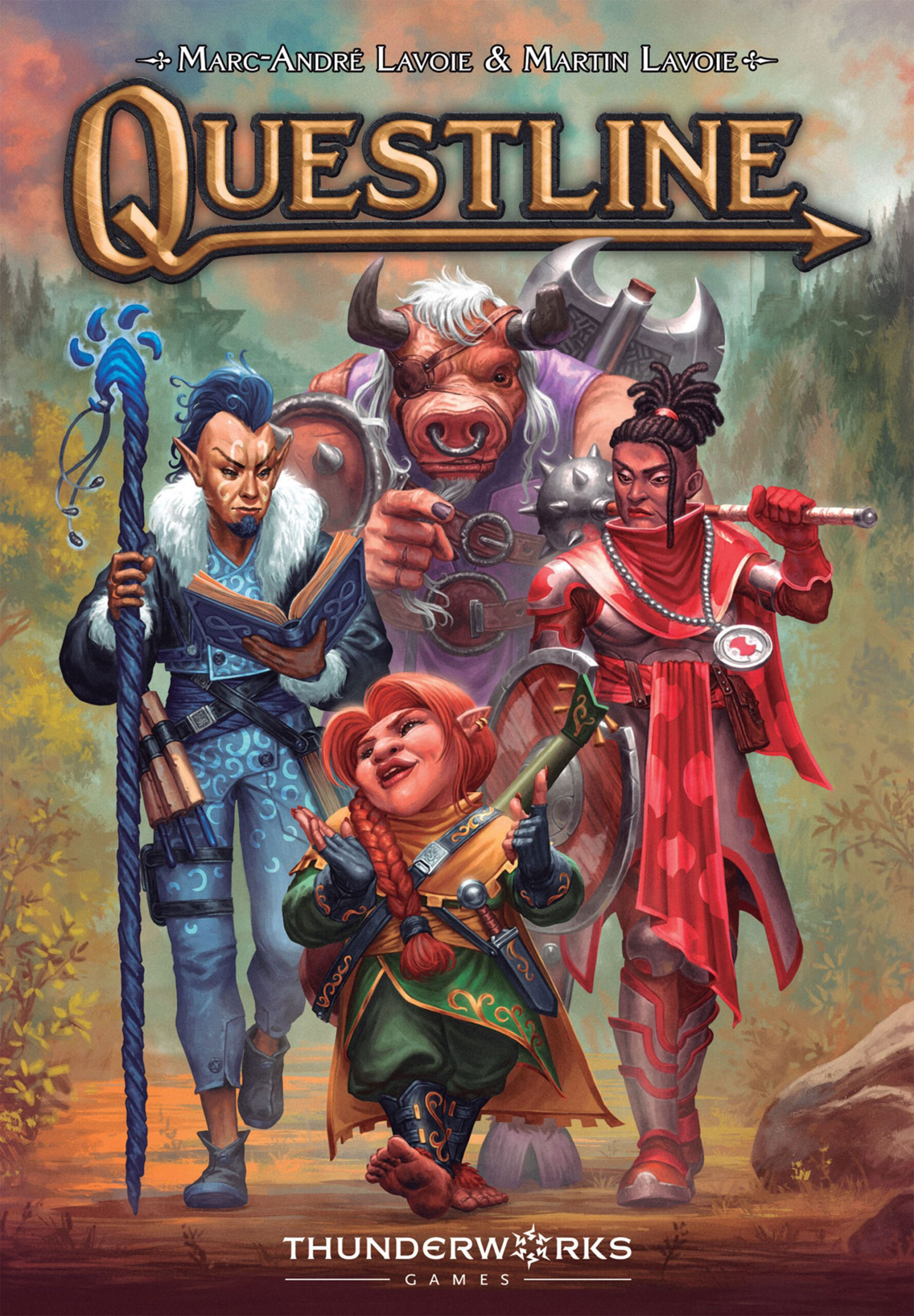 When I was first offered a review copy of Questline, I’ll admit I had never heard of it. Some quick research revealed that it is a small-box filler game for 1-6 players that plays like Fantasy Realms, but with a few twists. Fantasy Realms (and its derivative Fantasy Realms: Greek Legends) is probably my most-played filler/travel game of all-time, so honestly, that’s all I needed to know to get excited. Published by Thunderworks Games, some of the key twists in Questline include real-time card play, sequence-dependent scoring reminiscent of Faraway, and a fantasy-themed storytelling element at game-end. Does the total package constitute an epic journey worthy of retelling?
Gameplay Overview:
Set-up for Questline involves dealing each player 8 cards: 2 from the hero class and 6 adventure cards. Everyone discards 1 card to their personal discard area, and then the game begins.
Play is simultaneous, but the main action of any “turn” will be to draw a card
- Blindly from the hero or adventure deck
- From your own discard area
- From one of your opponents’ discard areas
At the end of every turn, you must discard back down to 7 cards, placing an unwanted card into your discard area. Once your discard area reaches 7 cards, you are no longer eligible to draw new cards from the decks or your opponents’ discards; you may only further optimize your hand from among your current discards.
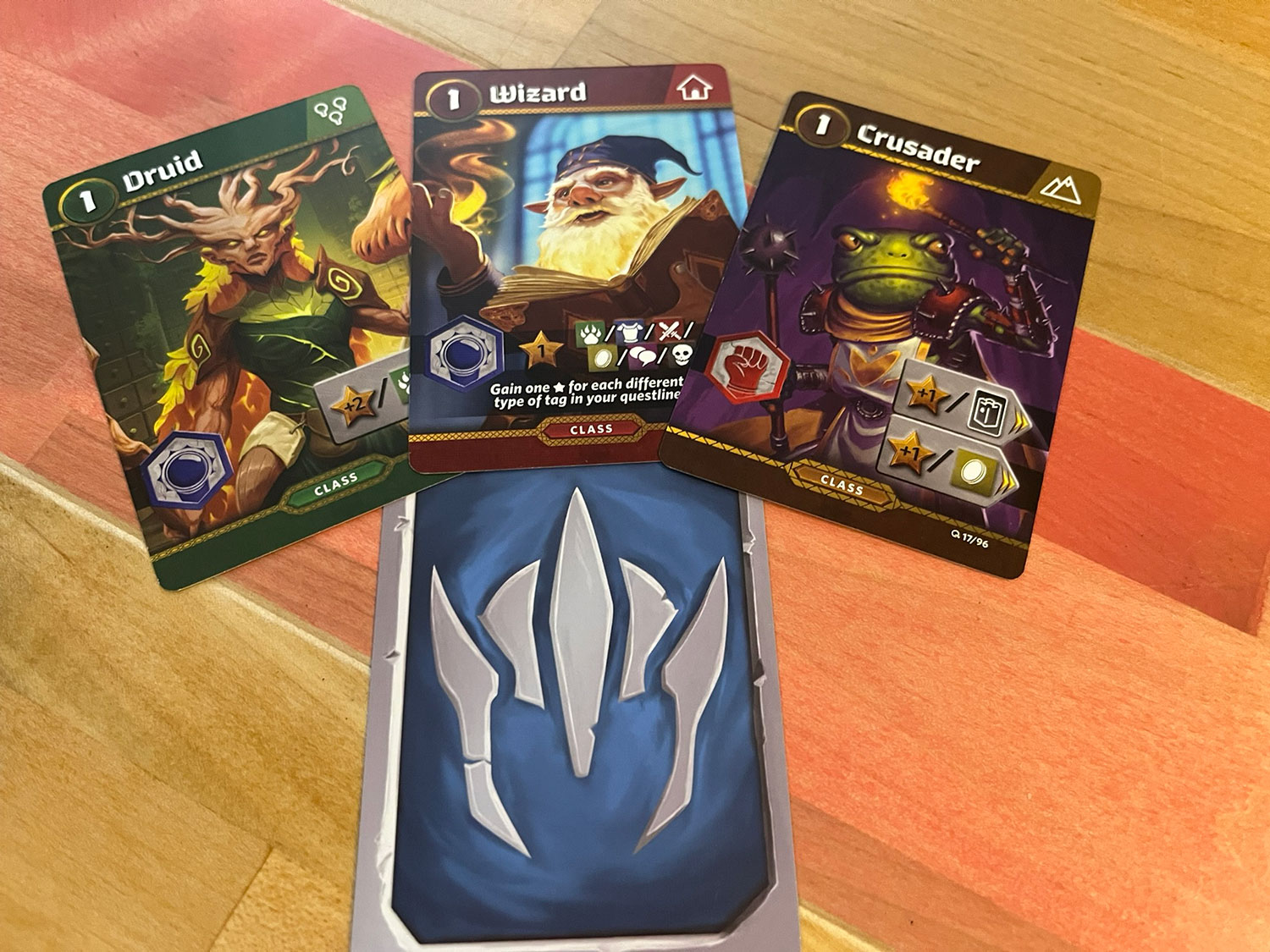 A selection of Hero Cards: all are level 1 and have a unique scoring condition.
Once you are sufficiently satisfied with your hand, you end your game and grab an epilogue card; players who pass first get dibs on the highest point-value epilogues.
Lay out your cards in your chosen linear sequence and then commence with scoring.
Scoring is based on:
- Base points listed on each card
- Bonus scoring conditions on certain cards requiring specific card suits or specific tags on cards located to their left or right
Notably, each card contains a number in its upper left corner representing its level, and for any given card to be eligible to score, its level must be preceded by all sequential whole numerical level values leading up to its own value. So to score a level-4 card, it must be preceded by levels 1, 2, and 3. That 4-card can then be followed by a 5, or any repeated lower value. If there are any numerical “holes” in your questline, they must be filled by the last card in the line, which will not score.
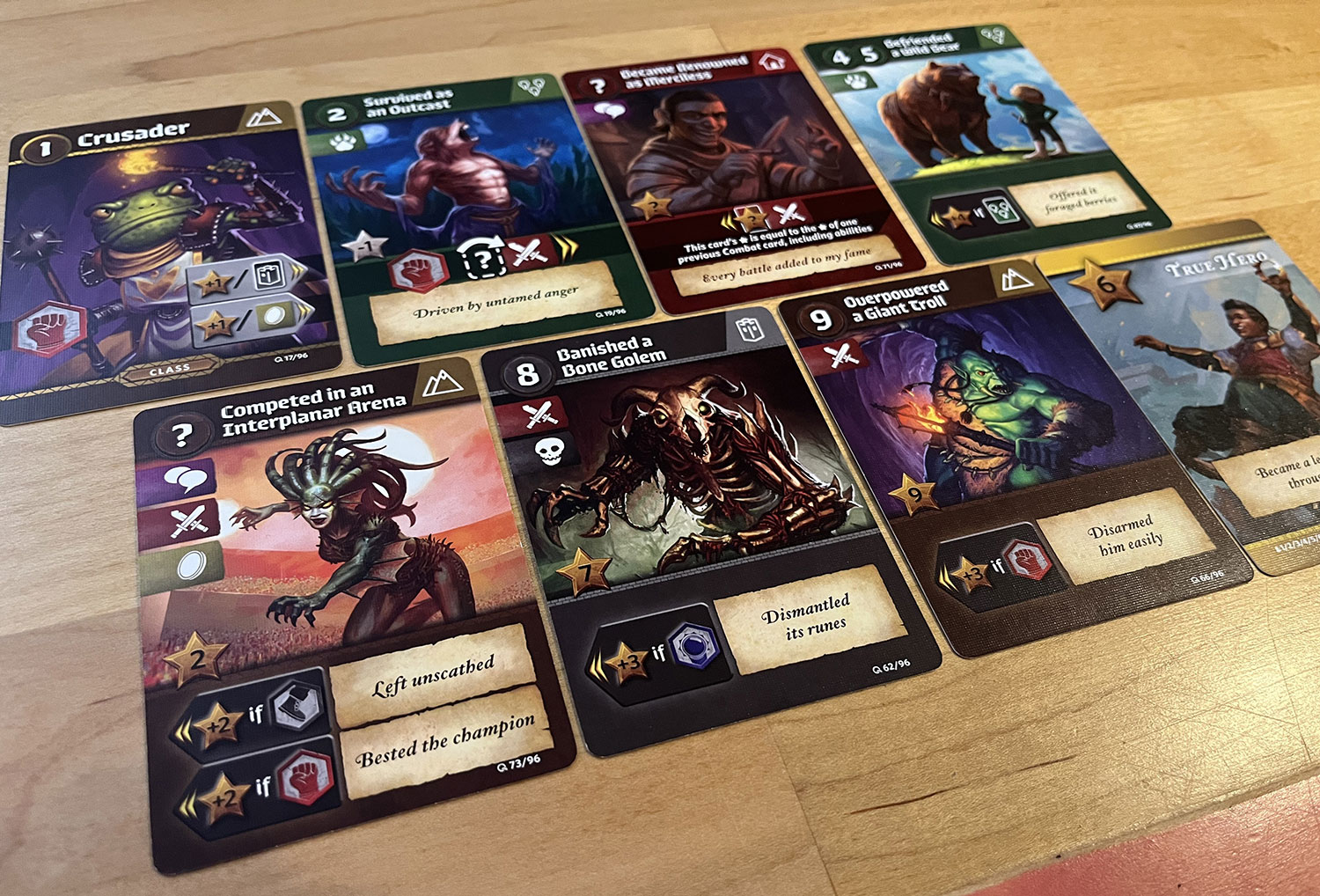 A sample end-game Questline, read left-to-right, top-to-bottom. The first card represents the hero of your story, the middle cards are Adventure cards, each with a unique plot point and flavor text. The final card is an epilogue showing your hero’s fate.
Game Experience:
Questline does have a lot in common with Fantasy Realms in that you’re attempting to optimize a hand of 7 cards, and to maximize your score you’re encouraged to find cards that synergize together well. Questline cards come in four distinct suits (or terrain types); they may contain 0-3 tags (among 6 types), and 0-2 skill icons (among 3 types). Many cards provide bonus points for certain tags, terrains, or skills located to their right or left, and some will cancel out certain skills if they’re in play. Even though your hand is only 7 cards, it is quite the brain-burning experience to optimize among all these parameters.
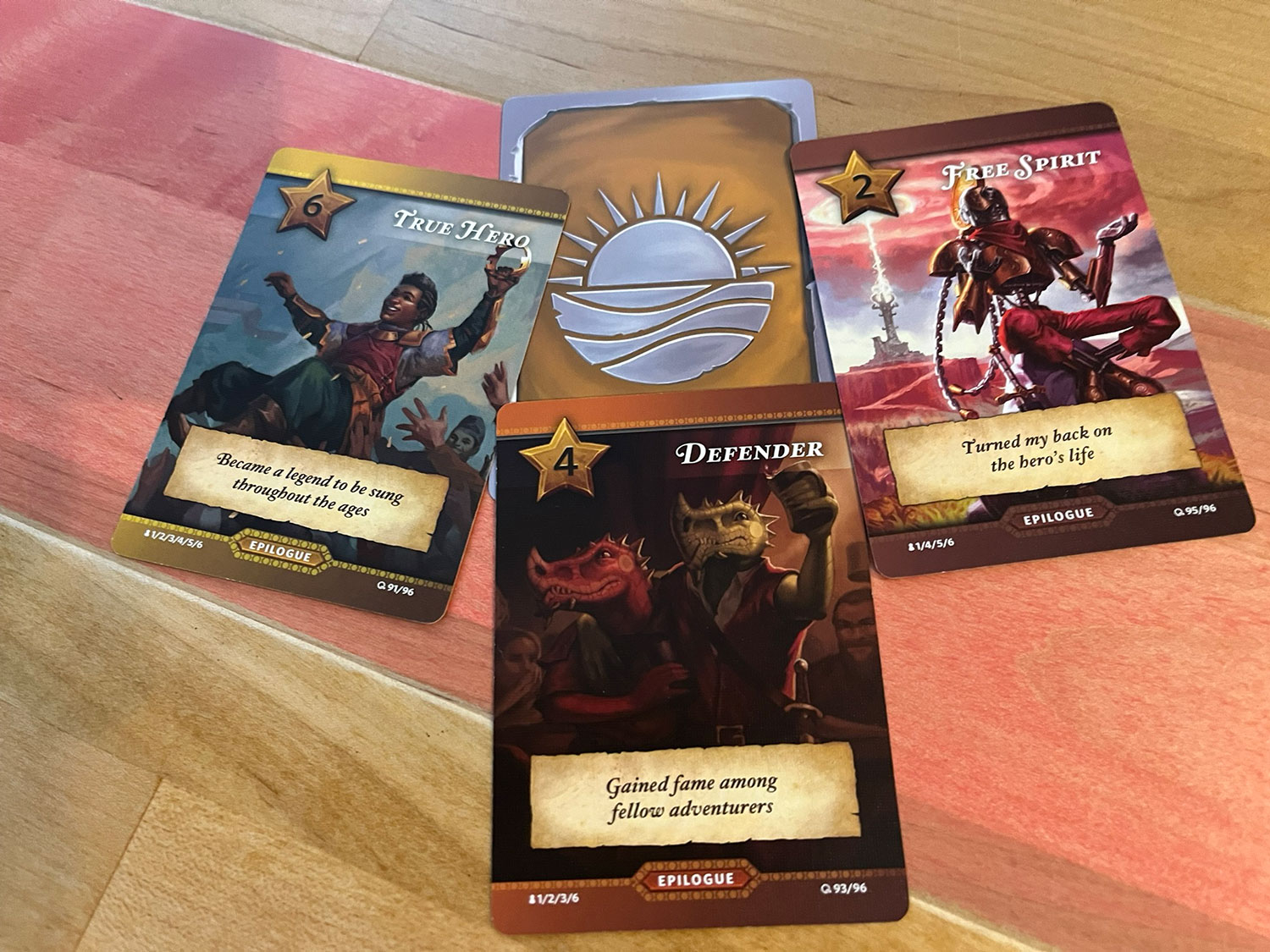 Sample epilogue cards: early finishers can earn the labels “True Hero” and “Defender” whereas, a late finisher might be called “Free Spirit.”
Because there are so many factors to consider for hand optimization, the real-time nature of the game works surprisingly well. In all my plays, Questline was never a frantic race of players quickly drawing and discarding cards. It does not have the same level of urgency as other real-time games like MD Rush and Fit-to-Print. Rather, players carefully considered available cards in all discard piles before deciding to draw one of those or a blind one. They then thoroughly studied their current hands to decide what to discard. After all, once you discard, there’s no guarantee you’re getting that card back. Also, assuming nobody else takes any of your discards, you may only get 6 total blind draws before your game is basically over. The main aspect influenced by the real-time nature is having to decide if your current hand is “good enough” or if it’s worth risking a lower-value epilogue card if you continue to try optimizing.
The storytelling element of the game was mildly amusing. Each normal card contains an event up top, like “rescued a halfling in peril,” as well as flavor text on the bottom, like “swiped a memento from its grave.” Lower numerical cards tend to have more mundane or preparatory events like “studied with the war elves,” whereas larger numerical cards relay more impressive feats like “Vanquished a flame hydra.” All together, your Questline tells a passable, if somewhat random tale grounded in the Ulos fantasy universe. I personally would have appreciated a bit more humor in the overall tone of the storytelling text as opposed to the more dramatic one they went with. Then again, I’m not someone who typically plays story-based games; I consider experiences like Tales of Arthurian Knights “just okay.” For me, Questline’s storytelling element was neutral to the larger experience, but some people might quite enjoy it.
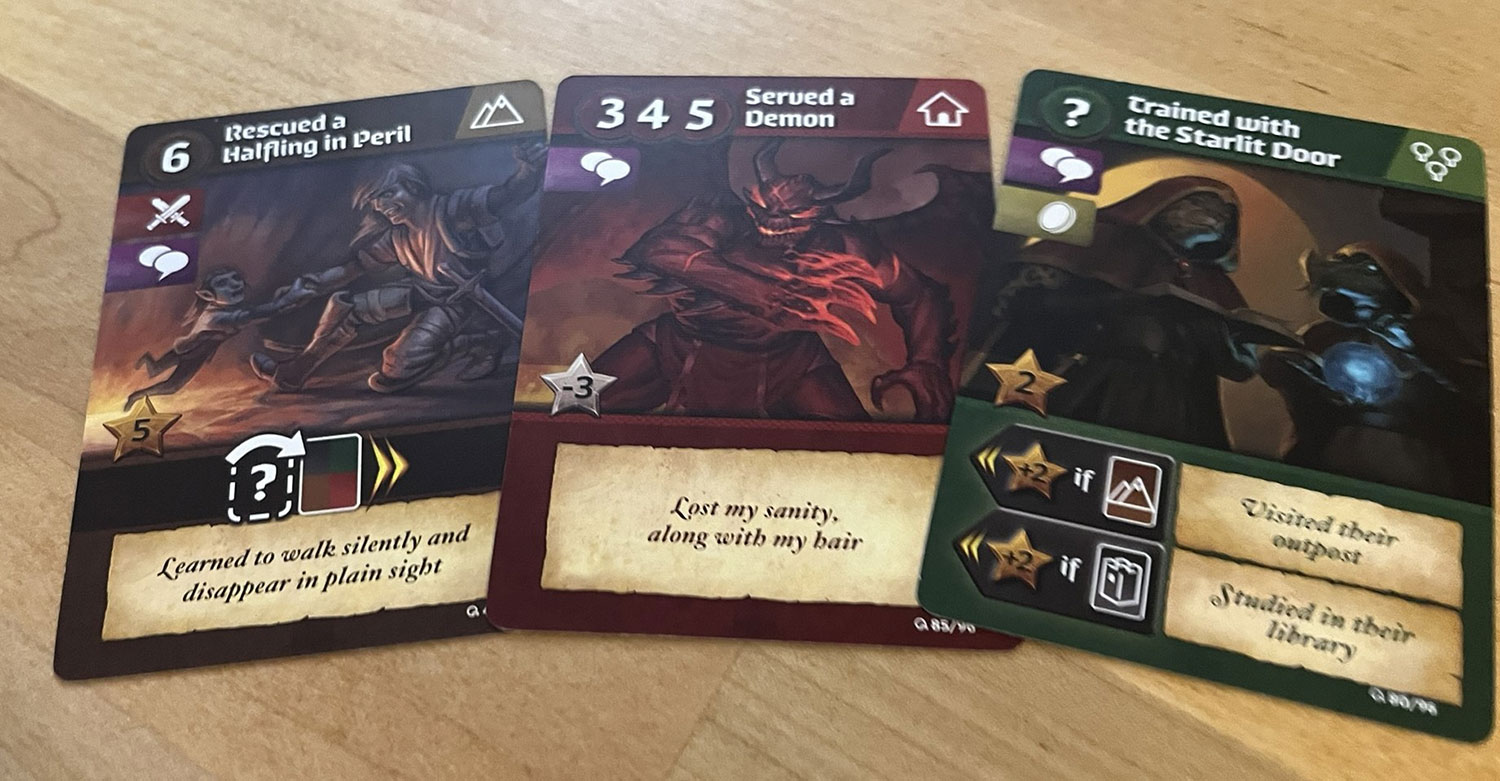 Some cards make it easier to reach high ranks in your questline. The leftmost card has a special ability that bends the rank-ordering rules, the middle contains 3 ranks, and the rightmost has a “wild” rank that can be filled in anywhere.
The final twist of Questline that must be discussed is the requirement of ordering your cards, largely in ascending numerical order and then assessing bonus points based on the location of certain tags and terrains to the right and left of each card. At face value, this seems like a cool idea, and in a game like Faraway, I quite enjoy it. However, in Questline, after several plays I started to notice that the winner seemed to always be the player who had managed to get higher level cards in play, which tend to contain higher base values. Scoring multiple high-level cards (say 8, 9, 10) when your hand is limited to 7 cards means you must seek out cards that either contain multiple numbers in their corner—and yes, there are cards with 3,4,5 or 7,8 or the like on them. Alternatively, you must find cards containing a special ability allowing you to skip certain numbers.
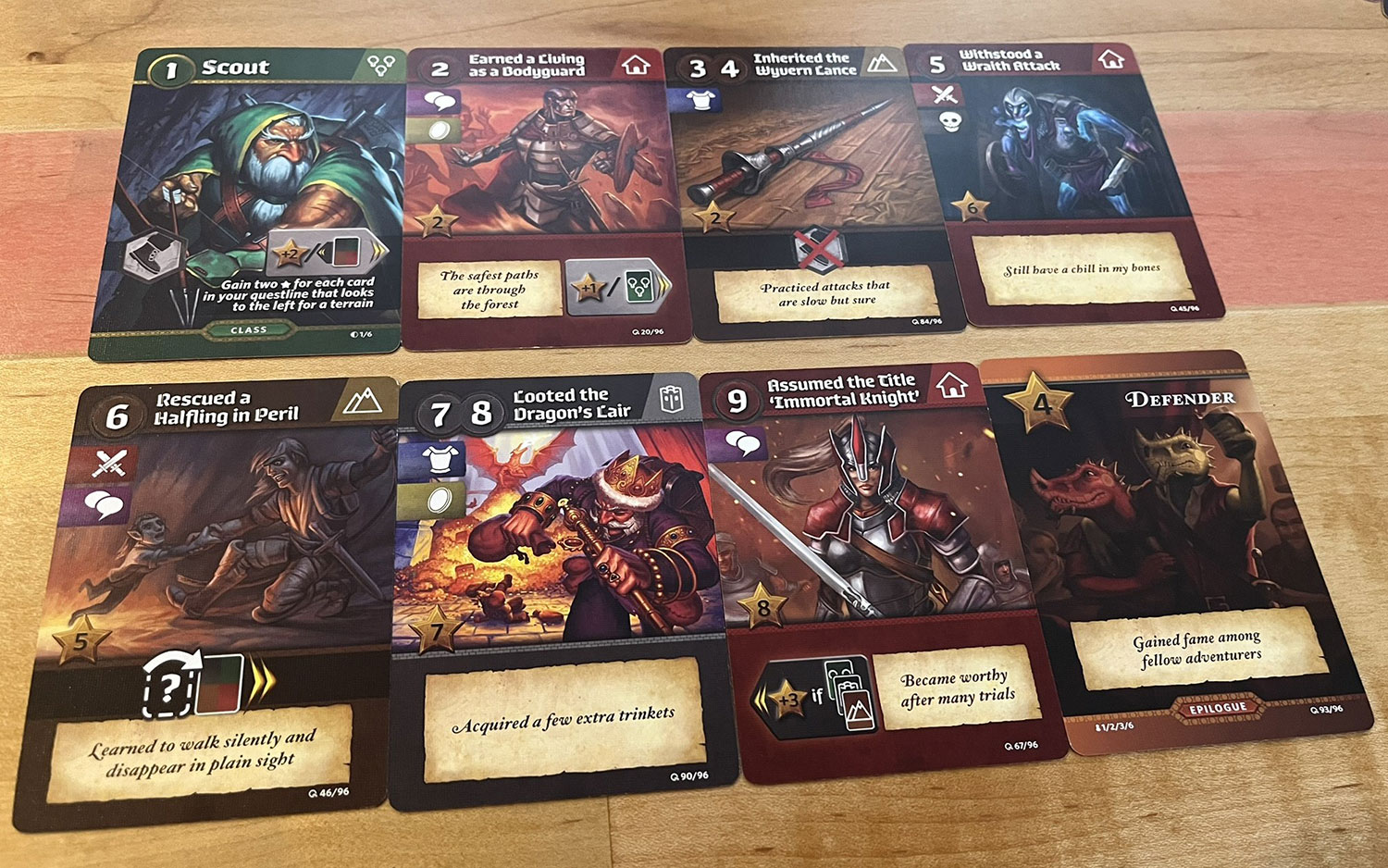 A sample end-game Questline hand, read left to right starting with the top row.
The importance of building an unbroken numerical sequence or finding rule-breaking cards so you can score 2-3 high-level cards means that in a game with 4 terrains, 6 tags, and 3 skill varieties available among the cards, you’re often just searching for cards with the right level numbers in the corner and ignoring many of their other features, which is just not that interesting. Rather than optimizing each of 7 cards for their unique requirements, the easiest play is to optimize 2-3 cards for maximal scoring and ignore everything else in search of the right numerical level. Essentially, I found the numerical sequencing requirement overly restrictive such that it made Questline difficult to find synergistic scoring opportunities, decreased the amount of swapping of discards among players (compared to Fantasy Realms), and overall made the game less fun.
Final Thoughts:
Questline is indeed similar in its gameplay mechanics to a game like Fantasy Realms. The twist of real-time card play works well, helping to keep everyone constantly engaged and allowing players nice agency in deciding when their hand is close enough to optimized. Some gamers will probably enjoy the storytelling element as well, especially if that’s a feature they usually seek out in games; for me, the story presence and quality were a net neutral. As someone focused mostly on mechanics, that’s where Questline falls flat for me. The restriction of finding cards containing sequential numbers (lest they not score) limited opportunities for engaging with the full breadth of terrain, tags, and skills present on the cards, which just made the game less interesting to me. I’ll give credit to Questline for pursuing some interesting ideas, and succeeding with some of them, but at the end of the day, I’d much rather play Fantasy Realms.
Final Score: 2.5 stars—A simultaneous filler game whose fun-factor doesn’t quite match its epic fantasy theming
 Hits:
Hits:
• Simultaneous gameplay keeps players engaged
• Excellent card quality
• A somewhat amusing storytelling aspect to your final hand
Misses:
• Overly restrictive card sequencing overshadows more interesting game elements


/pic9767863.jpg)







 English (US) ·